Showing posts with label novel. Show all posts

Monday, 28 April 2014

By any other name . . .

Shakespeare: A godsend for authors in search of a title
For a long time my first novel was going to be called The Shilling Rope. This had absolutely nothing to do with the plot, but popped into my head when I visited the archives at Berwick-upon-Tweed and was shown an 18th‑century hangman's bill. Among his charges was a shilling for the rope, which apparently did not change however much rope was required. 

The sequel, when I decided to write one, was to be called The Bastardy Bond. This was a term I came across when researching genealogy, the business of one of my main characters. But as I learnt more about publishing, I realised (duh!) that neither of these titles works for modern-day crime fiction. That said, I still think they're good titles and in the unlikely event that I ever turn my hand to historical fiction, I may use them.

A book's title has the same job as its cover design: it should entice the reader and suggest a little of what they can expect to find inside. Once I had taken this on board, I set about finding a proper title for Book One. The received wisdom (don't ask me where I heard this) is that crime novels sell particularly well if they have the word ‘death’ in their titles. Recognising that as a first-time, self-publishing author I need all the help I can get, I decided to come up with a title which included the word ‘death’.

First of all I turned to my dictionary of idioms. Among the many sayings using ‘death’ are:

  • In at the death
  • Catch one's death
  • Death trap
  • Kiss of death
They all sound horribly familiar, clichéd even, don't they? 
So my next step was to bring out my dictionary of quotations and look up ‘death’ in the index. Shakespeare, Tennyson and the Bible used this word a great deal! 

However, when I started reading the quotations in detail, I got a surprise. It became apparent that some of the best known and most effective crime fiction titles, although based on literary works and quotations about death, do not necessarily feature the word itself.

Agatha Christie did use ‘death’ and ‘murder’ in many of her titles: for example, Murder at the Vicarage, Death in the Clouds. The inspiration for titles like One Two Buckle My Shoe and A Pocket Full of Rye is obvious: nursery rhymes. (As an aside, my friend Bea Davenport’s next crime novel, out in October, is called This Little Piggy, demonstrating this can still be an inspired source.) But Christie also found her titles in more serious literature.

  • Pale Horse has its origins in the Bible. In Revelations you’ll find this: ‘And I looked, and behold a pale horse: and his name that sat upon him was Death.’
  • By the Pricking of My Thumbs is from a speech by the second witch in the play Macbeth. The full quotation is ‘By the pricking of my thumbs / Something wicked this way comes’
  • The Mirror Crack’d from Side to Side is from Tennyson’s ‘The Lady from Shalott’. The full quotation is ‘The mirror crack’d from side to side / “The curse is come upon me” cried / The Lady of Shalott’
The work of playwright John Webster, a contemporary of Shakespeare best known for his tragedy The Duchess of Malfi, has also provided several book titles, not all crime fiction:

·         Conference with the Dead (Terry Lansley)
·         Blood Flies Upwards (Elizabeth Ferrars)
·         Cover Her Face (PD James)
·         I Know Why the Caged Bird Sings (Maya Angelou, who doesn’t directly quote Webster but references the line ‘We think caged birds sing, when indeed they cry’.)

PD James takes this literary referencing even further. The title of her novel The Skull beneath the Skin is a quotation from TS Eliot about Webster in ‘Whispers of Immortality’: ‘Webster was much possessed by death / And saw the skull beneath the skin’. And in researching this post I found a book, now out of print, called By Death Possessed by the late Roger Ormorod.

So, did the title No Stranger to Death originate come from my wandering through The Oxford Dictionary of Quotations? Not directly, no. In fact, I had slammed the book shut in disappointment and gone to make a cup of tea. And then it came to me. Writing – in common with many other undertakings – can be like that. It’s only when you stop trying so hard that a solution to a problem shows itself. Which is perhaps why the title for Book Two came so easily: Too Soon a Death.

If you're a writer, how do you come up with titles? If you're a reader, do titles actually matter much when you're choosing what to read next? Do get in touch and let me know. I can be reached by leaving a comment below or clicking one of those buttons at the top of this page.

Shakespeare collection photo courtesy of freedigitalphotos.net

Thursday, 6 February 2014

Catching up


Three months ago, I released my first crime novel, No Stranger to Death, as an ebook. Shortly afterwards, I brought it out as a paperback too. Not only does this mean more people can buy it, but my book will soon be available in libraries throughout the Scottish Borders. It has received some great reviews on Amazon and GoodReads and continues to feature regularly in the Kindle Top 100 Scottish Crime Fiction chart.

Other writers and bloggers have helped me spread the word about my book, offering me guest spots on their own blogs and websites. I will always be immensely grateful to them for this support and encouragement. Soon, writing these guest blogs will be finished and I can concentrate on regularly posting on this site. In the meantime, here is a further list of where you can read about me and my book.

  • The brilliantly named Scottish crime-fiction blog, ‘There’s Been a Murder’ asked me some very challenging questions.
  • The inspirational ‘Fab after Fifty’ website included a piece in their Fabwomen blog on the ‘bucket list’ I wrote when I hit 50. Naturally this included publishing a novel but you may be interested in some of the other tasks I set myself.
  • A fellow crime-writer, Jane Isaac, invited me onto her blog 'Caffeine's not a Crime' to reveal how Scottish Borders settings influence my writing.
  • Mel Sherratt is a chart-topping crime-writer on both sides of the Atlantic who kick-started her career by self-publishing. I leapt at the chance to appear in her ‘Murder They Wrote’ slot when she invited me.

Mel and I at Harrogate 2013

Finally, for those of you who have read and enjoyed No Stranger to Death, I’m happy to say that I've started in earnest on its sequel. It will be out in the summer of 2015.

Friday, 11 October 2013

"Half the money I spend on advertising is wasted . . .


. . . Now, if I only knew which half."

I started off not knowing what to blog about this week. Not due to a lack of subject matter but because there is too much to choose from. You see, I’m planning the marketing campaign for No Stranger to Death.

Many people will probably equate marketing with paid advertising, but it’s actually so much more. And thank goodness for that. Like most self-published authors, I don’t have the money to spend on above-the-line promotion, so instead I must be inventive.

There’s no end of information on the internet for self-published authors. I use the term ‘no end’ purposely. Google ‘book marketing tips’ and you’ll get more than 58 million results (that’s more than Downton Abbey, though less than Miley Cyrus). Even working through the excellent post on the Your Writer Platform blog, ‘101 Quick Actions You Can Take Today to Build the Writer Platform of Your Dreams’, is a challenge. Of the 46 ideas I marked as worth considering, so far I've done . . . seven. 

As well as having to be inventive due to lack of budget, the self-published author must also maximise another scarce resource: time. This means I mustn’t waste my time telling people about No Stranger to Death who would never want to read it anyway. Quick Action number 4 of those 101 is ‘Research your target audience’, but I would put it at number 1. If I ruled the world, reading at least one book each month would be mandatory from the age of six. However, hard though it is hard to fathom, not everyone reads for pleasure and – even more shocking – not all readers enjoy crime fiction. So before I can start connecting with my potential readers, I need to find out who they are.

Here’s a question for you. Which of these people is most likely to be a crime (or, as they say in the USA, mystery) fiction reader?


It’s hard to find concrete evidence of exactly who reads crime fiction most avidly. I even searched the Open University digital library (which has information on everything) and came up empty. I’m sure large publishers have researched this, but they’re keeping such valuable information close to their chests. However, an article on the HarperCollins Killer Reads website, ‘Why are women so attracted to crime fiction?’, suggests it’s a given that far more women than men read crime. This is backed up by a survey carried out in 2012 on behalf of the Crime Writers’ Association, which states that the typical crime reader is ‘a woman, aged sixty-plus, married but with no children living at home . . .’

Although slightly older than I expected (until I remembered how old I am now), the CWA’s findings confirm what I suspected. I’m basing my assumptions on personal experience: years of meeting fellow crime fiction fans at events like CrimeFest and through social networking sites like Twitter. So the answer to my challenge is the older lady in turquoise (it’s not just crime fiction we have in common).

Now I know who my target audience is, but guess what? Turns out that’s the easy part. I need to decide how I’m going to reach them. That’s another challenge. And material for another blog post, as this one has gone on long enough.

Do you recognise this ‘typical’ crime reader? I’d like to know what you think. Please leave a comment below, or tweet me: @janetokane.

All pictures this week are courtesy of www.freedigitalphotos.net, and the quotation is attributed to John Wanamaker, a 19th-century pioneer in marketing.

Thursday, 4 October 2012

What type are you?


I’ve written before about trying to be less of a pantser and more of a plotter now I’m writing my second novel.  This has met with some success. Although I’ll never reach the stage of outlining an entire plot before starting to write, one approach is producing such good results that I doubt I’ll ever stop using it.  I’ve mentioned this in an earlier blog post: developing characters with the Myers-Briggs Type Indicator (MBTI), as recommended by Jeff Gerke in his excellent book Plot versus Character.

You can read in detail about MBTI on Wikipedia, but I don’t want to get too hung up on it, as it’s only a jumping-off point for creating rounded characters who behave in credible ways. In a nutshell, this psychological typing uses four opposing pairs of ways of thinking and acting (labelled dichotomies, although you don’t even need to know that).

  • Extraversion (E) – Introversion (I)
  • Sensing (S) – Intuition (N)
  • Thinking (T) – Feeling (F)
  • Judging (J) – Perception (P)
There are 16 possible combinations of these dichotomies, and there are tests you can do to find out what type you are.  According to the Humanmetrics Jung Typology TestTM  (which is free to take),  I am, apparently, an INFJ and I like what I read about them.

"INFJs are gentle, caring, complex and highly intuitive individuals. Artistic and creative, they live in a world of hidden meanings and possibilities. Only one percent of the population has an INFJ personality type, making the most rare of all types."
They are also ‘as genuinely warm as they are complex’ and are liable to have messy desks! 

All very interesting, you say, but how does this help to create compelling characters? I’ll give you a recent example. My novel calls for a person who runs my main character’s office. She’s reliable, to the extent of being put-upon, but has the potential to be dangerous if ever her devotion to her employer wavers. I’ve called her Helen for now.

Gerke’s book lists the 16 Myers-Briggs personality types with brief descriptions. I read down the list, looking for the one that sounds closest to the vague outline of the character in my head. One leaps out at me, though it’s usually not that clear-cut and I often have to take a second run at the list to identify the best fit. Helen feels like an ISFJ: A serious observer of others, overwhelming desire to serve others, often taken advantage of, responsible.

This is where I deviate from the process suggested in Plot versus Character. I google ISFJ (just the letters, you don’t even need to put in Myers-Briggs) and get page after page of profiles. They overlap, of course, but this serves to emphasise the most prevalent characteristics Helen should have. Then I transfer the characteristics I think are most important or could be useful to the story to one side of a table. Here are a few:

Prizes harmony, withdraws from conflict

An over-protective parent

Abhors waste of money

Rarely gets the praise/recognition deserved

Rich, inner world, excellent memory for details. Sensitive to others’ feelings

Respects tradition and laws

Learns best by doing, not reading theory

Has well-developed sense of space, function & aesthetics. Beautiful home, good interior decorator, great gift-giver

If has negative feelings, these may build up inside until they turn into firm judgements against individuals which are difficult to dispel

Has strong feelings of inadequacy

Family is central to life. Often possessive of loved ones. Has few close friends

Once that’s done, I fill in the other side of the table with examples of how these aspects of Helen’s character can be illustrated or used. Some are trivial: I’ve decided that because of her homemaking compulsion she buys fresh flowers every week for the office. Some may be problematic, e.g. ‘respects tradition and law’ if I decide to make her a suspect, but I can also use the table to see ways around these. So, if Helen can be persuaded to behave badly, this will probably come out of her devotion to her family. Some I leave blank if nothing comes to mind at this stage. I'll revisit this profile regularly when I'm plotting, and for writing scenes Helen appears in.

It took almost a day to create this profile of Helen, but I consider that time well-spent. I know her well enough to plunge her into the action. She’ll still surprise me – that’s one of the joys of writing – but I’m confident that I now have the tools to make her believable and well differentiated from my other characters.

Do you pre-plan your characters or do they develop organically as you write? I’d love to know, so please leave a comment below (if you can, I know Blogger is uncooperative sometimes). And if you try out the Humanmetrics Jung Typology TestTM  on yourself, tell me what you think of the results.

Wednesday, 5 September 2012

Going places

Picture by Paul Stevenson, @goldylookfleece
I’m doing my best to apply the lessons I learnt while writing No Stranger to Death to creating its sequel. This includes recognition of my shortcomings and finding ways around them, rather than railing against an inability to carry out tasks I’m certain other people could accomplish standing on their heads (which is itself a skill I never mastered).

Take descriptions, especially of buildings and places. I am, apparently, one of a rare breed: under-writers. My first draft of anything is pretty sparse and editing usually means adding words rather than taking them away. I lost marks for this in my most recent OU course, with my tutor telling me that although I ‘write well’, my sentences and paragraphs are far too short for the academic world. 

While a propensity for brevity isn’t necessarily a bad thing if your main aim is to tell a first-rate story, it does stand in the way of conjuring up the magic ingredient which writers these days are encouraged to strive for: a sense of place.

I didn’t choose to set my books in the Scottish Borders simply because it’s ‘what I know’, but more because it’s what my main character doesn’t know. As an incomer to rural Scotland from an English city, Zoe isn’t just challenged by unfamiliar people and disturbing events but by these alien surroundings. She comes across sights, sounds and smells she’s never experienced before, and yet – alright, I admit it, like me – she finds unexpected pleasure in many of them and gradually starts to feel at home. This is all part of her ‘journey’, her personal development.

So, how to convey what the Borders is like? I’ll leave it to VisitScotland to inform the world about our castles, abbeys, stately homes and museums, and Zoe is unlikely to take up golf any time soon. This is where a notebook, latterly a smartphone, comes in handy. Sometimes driving, more often walking the dogs, I record the small things I encounter. The blue flash of a kingfisher, the sound of a chainsaw in the distance (would a true ‘townie’ know what it was?), the smell of woodsmoke. Stuff that makes me smile, like watching a border collie (what else?) herd sheep up a narrow road, and that makes me sad, like a young deer dead on the verge.

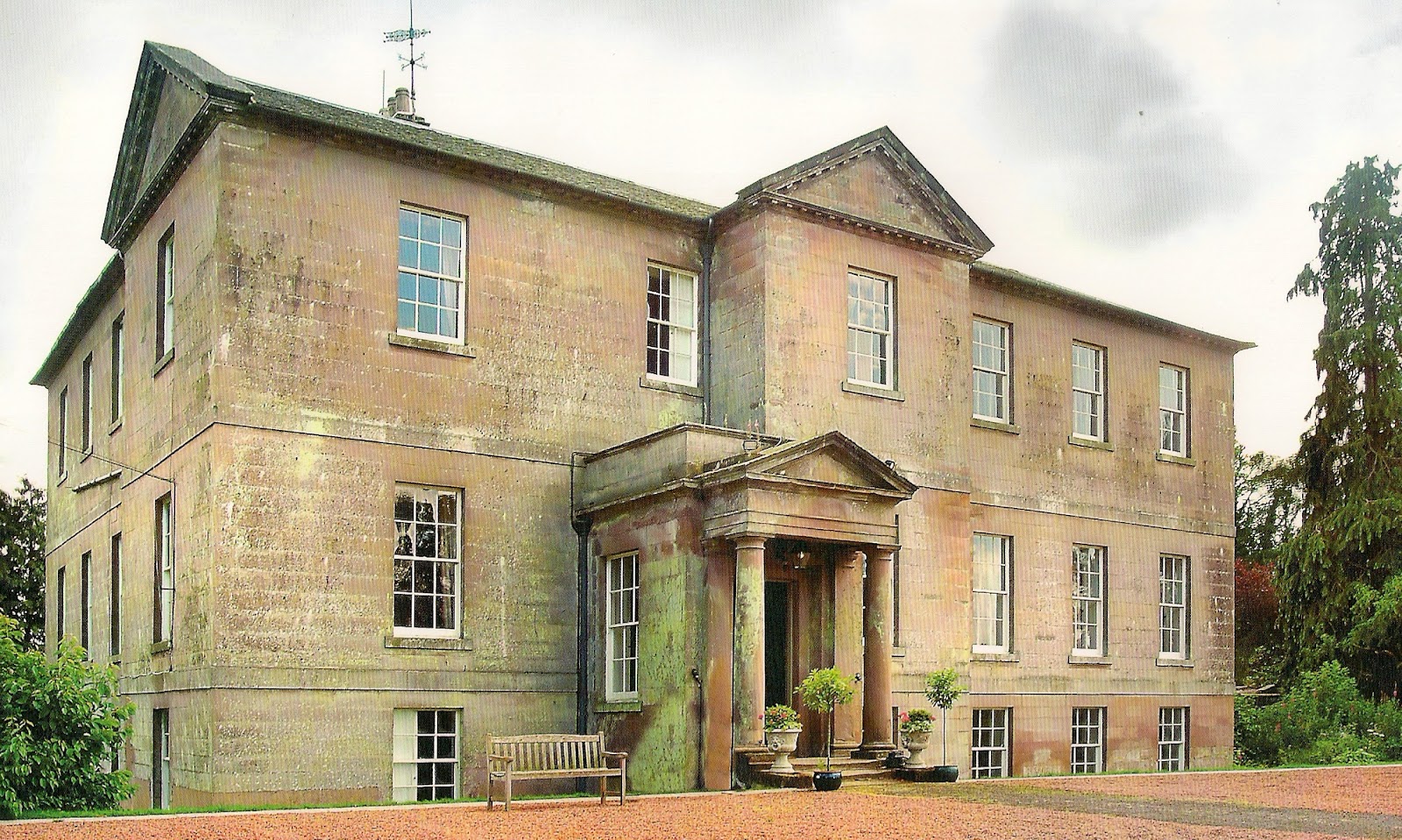
Rather than try to invent buildings, I use elements of existing ones. The picture below is  of a large house I’ve visited a few times in the past. Its frontage, galleried hall and huge coloured-glass skylight are combined in Book 1 with the kitchen and a dressing-room from another house I worked at for a time. 
An ideal setting for unpleasant goings-on?
For more general views of the area, I know I can turn to Twitter friends who are keen photographers. Paul Stevenson, who goes by the Twitter name of @goldylookfleece, kindly emailed me the gorgeous picture at the top of this post (and agreed to it appearing here) when I asked him if he had any landscapes with poppies.

When I need to write a detailed description of a particular setting, I go in search of one or maybe several which can be combined. Book 2 opens with the discovery of a body which has been pulled out of the River Tweed after being thrown off a nearby bridge. I was pretty certain the Union Chain Bridge, which links England and Scotland a few miles from Berwick-upon-Tweed, would be suitable.


The Tweed: England on one side, Scotland on the other

The Union Chain Bridge
I found lots of photographs online of this bridge, as it’s famous for being the oldest suspension bridge still carrying road traffic. However, my recent visit told me so much more than a Wikipedia entry and Flickr images could. For example, the Union Chain Bridge:
  • undulates when a car goes over it, which feels like you’re standing on a boat
  • creaks and groans, and if there’s a breeze the vertical struts rattle
  • is partly covered in green paint that’s flaking off in large patches
Not pretty but ideal for my purpose
These observations have enabled me to describe not just the bridge itself but Zoe’s experience of it. And – an unexpected bonus – that flaking paint has become a clue for the police when deducing how the body ended up in the Tweed. 

Perhaps when I’m published I won’t have time to research locations away from my desk. But until then I shall continue to seek them out, take photographs and note other details such as sounds and smells, to enrich my writing.

Do you feel the need to base your locations on real places, or is it just me?

Wednesday, 4 July 2012

Aspirations


Some things are impossible to explain. Like why I find the Scots accent irresistible, how I can be middle-aged when I still feel 22, and why it’s so important to me to gain something many of you had by the time you really were 22: a degree.

In my early 40s I studied English and Scottish Literature at Edinburgh University. It was a lovely time, unfortunately cut short by a lack of funds (grants had already gone, fees were just coming in, an idiotic bureaucrat ‘forgot’ to process my application for a bursary). I took a job which I hated, and to console myself I started to write seriously in my spare time. Yet that dream of achieving a degree never went away.

Several years later we were a lot better off but I could no longer face regularly driving 50 miles each way to Edinburgh. So I applied to study with the Open University. My time at Edinburgh gave me credits which meant I ‘only’ had to do four courses to gain a BA (Hons) in Humanities with Literature (though sadly without a specifically Scottish element). I was self-employed by then, and could work half the week, study the other half.

I did three courses in as many years, my favourite being History of Cinema and Television. My husband enjoyed all that mandatory film-watching; I hated having to take exams again. My marks were pretty good, once I stopped being pulled up for writing lines and paragraphs which were ‘too short’ (they probably lacked sufficient adverbs and adjectives as well). So I’m well on the way to achieving dream number 2: getting a degree.

However, dream number 1 – being a published novelist – still rules. I took 2011/12 off to complete my first novel, start my quest for an agent and begin writing book two. This week, as June became July, I faced a big decision. Is this the right time to embark on my final year of study, the most important course of them all, the one which decides how good a degree I get?

The answer had to be ‘yes’, even though it means I must be more organised. I’ll have to go back to designating set days for specific tasks, abandon the luxury of fiction-writing every day. And you know what? I think this will concentrate my mind, make me more productive, not less.

Arrgh!
Another choice: which course? I swithered between A300: 20th century literature – texts and debates and AA316: The 19th-century novel. Heaney, Woolf, Ginsberg, Du Maurier, Eliot and Brecht versus Austen, Bronte, Dickens, Eliot, Flaubert and Conrad. Conrad? Memories of A-level English all those years ago flooded back, of wading through Nostromo and hating every line of it.

The reading list for A300 also includes a Scottish classic, Lewis Grassic Gibbon’s Sunset Song, as well as sci-fi in the shape of Philip K Dick’s Do Androids Dream of Electric Sheep? Finally, the clincher: while both courses require six Tutor Marked Assignments (essays), only AA316 has an exam at the end of it. A300 has an End-of-module assessment which is done at home at one’s own pace.

Decision made. A300: 20th century literature – texts and debates, here I come! Eventually, I hope, earning the right to hire one of the fetching gowns seen here for my graduation ceremony.

Nineteenth or twentieth century literature: which would you choose?

Tuesday, 10 April 2012

Lucky 7: Seven lines from new works

Winter's Gate by Charles Simpson*

My thanks to both Susan Williams and Isabel Costello who have tagged me to take part in Lucky 7: Seven lines from new works. The rules are simple:

  1. Go to page 77 of your current MS or WIP
  2. Go to line 7
  3. Copy the next 7 lines, sentences or paragraphs and post them as they’re written
  4. Tag 7 more writers and let them know.
My list of 7 people I’ve tagged is at the end of this post. Who to choose was a tricky decision. In the end, I purposely chose writers who I haven’t followed on Twitter for very long, as I’d like to get to know them better. There’s absolutely no pressure to take part if you don’t want to or haven’t got time.

It’s been fascinating, reading other writers’ excerpts; I hope you’ll get something from mine too. These 7 lines are from my first crime novel, No Stranger to Death, which I’m currently transferring to Scrivener as a training exercise. Assuming I master the software, I plan to write the follow-up, which is at the planning stage, straight into it.

To put these words into context, you need to know that our heroine Zoe is in the pub with her new friend Kate who lip-reads because she’s deaf.


‘No one need hear, silly. You don’t have to talk out loud.’
Feeling foolish, Zoe silently mouthed an account of Hazel and Ray’s argument. Kate waited until she’d finished then, speaking more quietly than usual, asked, ‘Any idea what it was all about?’
‘Your guess is as good as mine. But it must have something to do with Chrissie’s death.’ Zoe brought out her purse, preparing to go up to the bar for more drinks.
The front door opened and Neil rushed in.
Over to you, if you’re so inclined:

 *Charles Simpson kindly agreed to my use of his image on my blog. I hope one day to own an original. You can see his work at http://www.csimpson-art.co.uk/

Saturday, 7 January 2012

A shiny new blog

Welcome to my new blog. You can still see the old one back at my website but technical difficulties have led me to create this freestanding one. So now I have no excuse for not blogging at least once a week.
I hope you like what you read here, enough to subscribe to new posts by email (see below) or to bookmark and drop by regularly. If you’re on Twitter, you can follow me – @JanetOkane – and as well as my regular, ahem, nonsense I’ll tweet whenever I put a new post up.
I’ve been thinking a lot about this blogging lark: why I’m doing it, what I should write about. My website went live two years ago and in the planning stages I decided it absolutely, definitely had to include a blog. This was in order to ‘build a platform’, an essential (apparently) for any writer who’s serious about getting published.
Ugh! What a dispassionate expression ‘building a platform’ is. ‘Networking’ is nearly as bad, ‘making connections’ less so but still not ideal. These words reek of technology, not the uniquely human activities of writing and reading.
We writers may spend much of our time at keyboards but we’re not machines. And nor are the agents, publishers, editors and readers we want to take notice of our work.
Two years ago I imagined I would blog solely about writing. It didn’t turn out that way. It’s fine to report on Twitter (in 140 characters or less) one’s word count for the day and one’s satisfaction/disappointment with that achievement. Blogging, though, demands a whole lot more. It should be entertaining or informative. The best blogs manage to be both. But an account of the minutiae of my writing life would hardly be diverting, and as I’m still learning my craft I have no authority to lecture others on how to do it.
Writing is, after all, only part of my life, albeit a huge one. This is the year I start sending out my first novel to find an agent, and start writing my second. I’ll share as much of this as I feel able. But because I’m not a machine and I’d like you to get to know me, this blog will also embrace several other areas of my life.

You can probably predict my taste in books and TV: yes, usually crime (and never reality programmes). My choice of films and music is more eclectic. While I don’t plan to become a review site, I’ll write about highlights and low points in my experience of these different media.
I know from Twitter how different my everyday life is to that of most people I follow. It’s hardly the one I expected for myself. Back in 1980s London I was a yuppy, working long hours but not letting that stop me from going out every night. I was on track to have, by the age of 35, a middle-management husband, two children, and a house in Surrey. Yet here I am now, settled in rural Scotland, 50 miles from the nearest John Lewis.
My husband runs his own, successful business but doesn’t possess a suit or tie (though he does have a fetching custom-made kilt). We drive his 'n her pickups. I’m happily childless and lavish care on a geriatric cat, three dogs and around 20 chickens. The rhythm of our lives is dictated by the seasons, the weather, the rising and setting of the sun. This sometimes isn’t as romantic as it sounds.
In my yuppy days I was sent on assertiveness training (cue howls of laughter from those who know me). The one thing it taught me was how to overcome the typically female trait of not being an ‘effective greeter’. So, with a firm handshake and making confident yet non-confrontational eye contact, I say again:
Welcome to my blog.