Showing posts with label OU. Show all posts

Thursday, 4 July 2013

On no longer being a student


So, farewell Open University. It’s been great, even though sending off the final assignment of my final course was an anticlimax. That’s the trouble with living miles from the nearest shop and working from home: no easy way to buy cakes and no one to share them with. Now I have to wait until August to find out my final mark for A300 Twentieth Century Texts and how good a degree it’s helped me achieve. I’m lucky that nothing but my self-esteem depends on this outcome, but I’m still anxious to have done well.

I’ve written before about how I ended up doing an OU degree so I won’t repeat that. Here are the modules I studied (a year at Edinburgh University saved me two OU ones):

·         A207: From Enlightenment to Romanticism, 1780-1830. This wide-ranging course covered music, philosophy, science, poetry, drama, art, architecture and social history. The essays I wrote included ones on Goethe’s Faust, Mozart’s Don Giovanni, Turner’s depiction of the Battle of Waterloo, and Robert Owen’s social experiments at New Lanark.
·         A215: Creative Writing. This course included, as the OU website puts it, ‘exercises and activities designed to ignite and sustain the writing impulse’. As well as short fiction, we produced poetry and travel-writing. Each piece of work submitted had to be accompanied by a reflective commentary, providing details of how it was conceived, the process of drafting and editing, and how difficulties were overcome. Quite a lot more than answering that old chestnut 'where do you get your ideas from?'.

Monument Valley
·         AA310: Film and Television History. This was by far my favourite course, not least because it necessitated watching lots of DVDs! I studied, among other film genres, westerns (which inspired our visit to Monument Valley in 2011), British war films, 1960s spy thrillers and post-WW2 European cinema. The TV element included sci-fi and soaps. I did my end-of-course project on the classic serial on British television, writing about the adaptations of I, Claudius (first shown in 1976, and again very recently) and Moll Flanders (1996). 
·         A300: 20th-Century Texts. This was my final course and I’ve blogged about it in some detail already.

The benefits of studying with the OU have turned out to go far beyond interpreting texts, remembering facts and getting good grades.  Here are just a few of the things my studies have taught me about myself:

·         I can take on a huge commitment (both in terms of time and effort) and see it through to the end.
·         I work best with deadlines.
·         Few tasks are insurmountable. I’ve lost count of the occasions when I read an assignment title for the first time and thought ‘I can’t do this’. But I did. With one exception (see below).
·         I discovered I can’t write poetry to save my life, although I do enjoy reading and studying other people's.
·         I may be a pantser when writing fiction, but when it comes to academic writing I’m a planner through and through.
·         I enjoy reading ebooks for pleasure but when I’m studying, a physical book wins every time. 

I'm now familiar with words like palimpsest, hypallage, scotoma, hermeneutic, belleslettres and more –ologies than you can shake a stick at. And I learnt other lessons too, like always prepare for the unexpected, especially when a deadline looms. I managed to cope when a virus rendered my computer inoperable a week before an essay was due in, mainly by making the engineer feel so sorry for me that he moved my job to the front of the queue. But what on earth was I supposed to do when the handle mechanism on my study door broke the day before an essay was due in, leaving me unable to get inside the room? I had to wait until my husband came home and kicked the door open. It was such a bizarre excuse for needing an additional day that my tutor had to believe me.

So, will my experience of studying with the OU help my career as a writer?  Look again at the things I’ve learnt: commitment, working to deadlines, persevering with seemingly impossible tasks. I think the answer has to be ‘yes’, don't you? 

I'll definitely be celebrating in August with ice cream cakes from Giacopazzi's!

Wednesday, 5 September 2012

Going places

Picture by Paul Stevenson, @goldylookfleece
I’m doing my best to apply the lessons I learnt while writing No Stranger to Death to creating its sequel. This includes recognition of my shortcomings and finding ways around them, rather than railing against an inability to carry out tasks I’m certain other people could accomplish standing on their heads (which is itself a skill I never mastered).

Take descriptions, especially of buildings and places. I am, apparently, one of a rare breed: under-writers. My first draft of anything is pretty sparse and editing usually means adding words rather than taking them away. I lost marks for this in my most recent OU course, with my tutor telling me that although I ‘write well’, my sentences and paragraphs are far too short for the academic world. 

While a propensity for brevity isn’t necessarily a bad thing if your main aim is to tell a first-rate story, it does stand in the way of conjuring up the magic ingredient which writers these days are encouraged to strive for: a sense of place.

I didn’t choose to set my books in the Scottish Borders simply because it’s ‘what I know’, but more because it’s what my main character doesn’t know. As an incomer to rural Scotland from an English city, Zoe isn’t just challenged by unfamiliar people and disturbing events but by these alien surroundings. She comes across sights, sounds and smells she’s never experienced before, and yet – alright, I admit it, like me – she finds unexpected pleasure in many of them and gradually starts to feel at home. This is all part of her ‘journey’, her personal development.

So, how to convey what the Borders is like? I’ll leave it to VisitScotland to inform the world about our castles, abbeys, stately homes and museums, and Zoe is unlikely to take up golf any time soon. This is where a notebook, latterly a smartphone, comes in handy. Sometimes driving, more often walking the dogs, I record the small things I encounter. The blue flash of a kingfisher, the sound of a chainsaw in the distance (would a true ‘townie’ know what it was?), the smell of woodsmoke. Stuff that makes me smile, like watching a border collie (what else?) herd sheep up a narrow road, and that makes me sad, like a young deer dead on the verge.

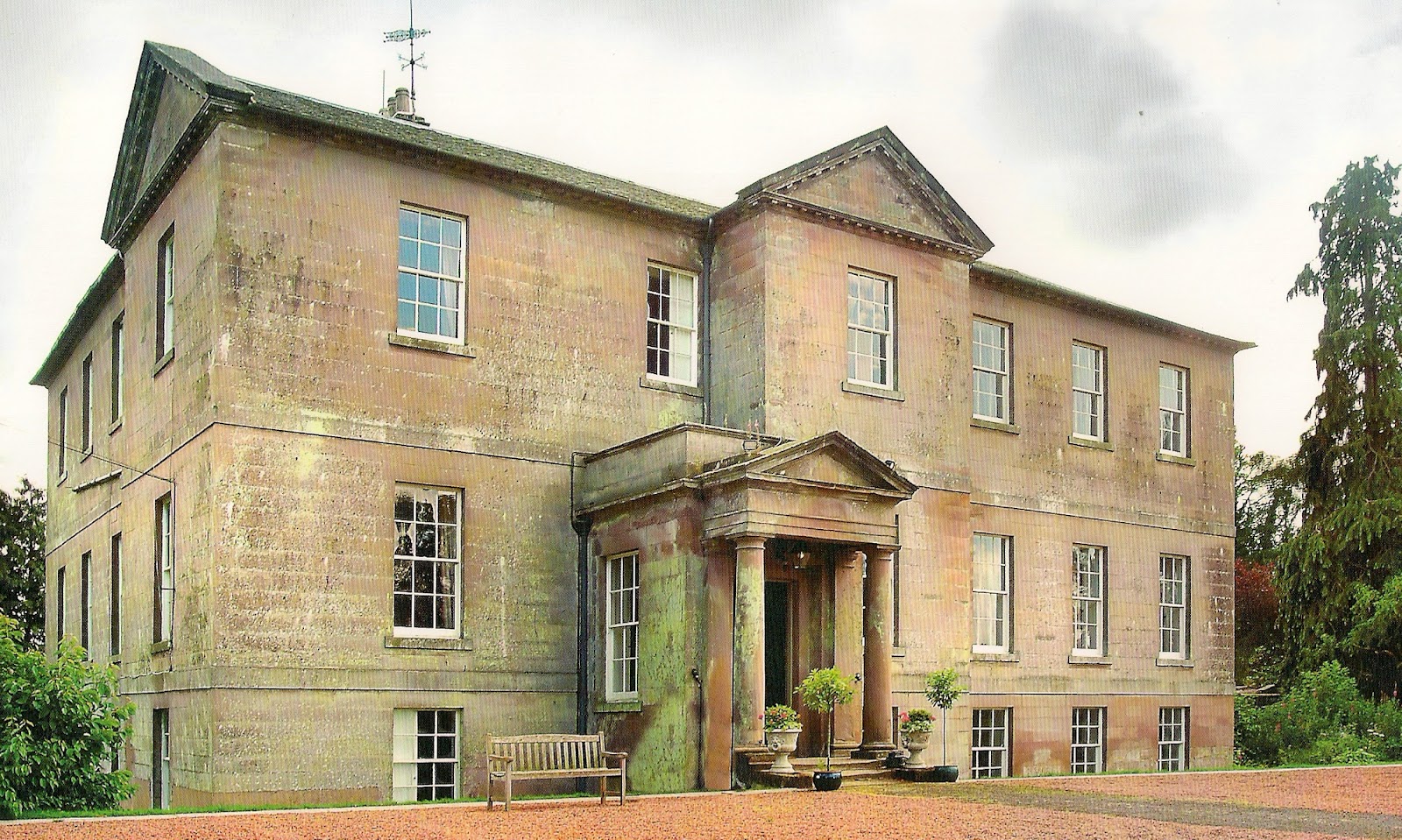
Rather than try to invent buildings, I use elements of existing ones. The picture below is  of a large house I’ve visited a few times in the past. Its frontage, galleried hall and huge coloured-glass skylight are combined in Book 1 with the kitchen and a dressing-room from another house I worked at for a time. 
An ideal setting for unpleasant goings-on?
For more general views of the area, I know I can turn to Twitter friends who are keen photographers. Paul Stevenson, who goes by the Twitter name of @goldylookfleece, kindly emailed me the gorgeous picture at the top of this post (and agreed to it appearing here) when I asked him if he had any landscapes with poppies.

When I need to write a detailed description of a particular setting, I go in search of one or maybe several which can be combined. Book 2 opens with the discovery of a body which has been pulled out of the River Tweed after being thrown off a nearby bridge. I was pretty certain the Union Chain Bridge, which links England and Scotland a few miles from Berwick-upon-Tweed, would be suitable.


The Tweed: England on one side, Scotland on the other

The Union Chain Bridge
I found lots of photographs online of this bridge, as it’s famous for being the oldest suspension bridge still carrying road traffic. However, my recent visit told me so much more than a Wikipedia entry and Flickr images could. For example, the Union Chain Bridge:
  • undulates when a car goes over it, which feels like you’re standing on a boat
  • creaks and groans, and if there’s a breeze the vertical struts rattle
  • is partly covered in green paint that’s flaking off in large patches
Not pretty but ideal for my purpose
These observations have enabled me to describe not just the bridge itself but Zoe’s experience of it. And – an unexpected bonus – that flaking paint has become a clue for the police when deducing how the body ended up in the Tweed

Perhaps when I’m published I won’t have time to research locations away from my desk. But until then I shall continue to seek them out, take photographs and note other details such as sounds and smells, to enrich my writing.

Do you feel the need to base your locations on real places, or is it just me?