Showing posts with label Scottish Borders. Show all posts

Monday, 17 February 2014

Things they don’t tell you about being an author ...

... Number 1: Writing a sequel isn’t easy

The River Tweed on a summer's day
When I started to write No Stranger to Death, I had no intention of it being anything other than a standalone novel. Bad things would happen in the Scottish Borders village of Westerlea, my heroine Zoe Moreland would save the day, and that would be that. But when I got to the end of the first draft, Zoe’s story was far from over. Of course, I had the power to change this, but I didn’t want to. So, instead of editing out situations which couldn’t be resolved or creating over-neat outcomes, I decided to write a sequel.

What bliss, I thought, to be able to pick up where I left off. I could use the same settings, and those characters I already know well would be waiting for me to prod them back into action. Also, what better way to build a following than have readers put down No Stranger to Death so desperate to find out what happens next that they rush to buy its follow-up?

Silly me! I’m now faced with decisions to make and challenges to meet that might not be necessary if I was creating a fictional world from scratch. And I’m not just talking about remembering the colour of a character’s eyes.

Does Book 2 work on its own?
This is the big one: a sequel must not rely on the first book to be enjoyable. In that respect, all books are standalones, especially as readers don’t necessarily consume them in the order in which they’re published. Knowledge of what went before can increase the reader’s pleasure, but a story which relies on this to entertain is a cop-out. To that end, Book 2 will involve Zoe getting caught up in entirely new and very different crimes to those in No Stranger to Death.

How much back-story to tell?
Back-story is a tricky thing to get right at the best of times. Too much can slow up the action and risks spoiling the enjoyment of readers who then move on to the first novel. But too little could raise questions which distract from the narrative, even in a crime novel aiming to intrigue the reader. I’ve found this testing from the very first page, when Zoe is visited by the police asking for help in identifying the body of a young man found dead on the banks of the River Tweed. She reveals something about herself that anyone who has read No Stranger to Death will find significant but which readers who are encountering Zoe for the first time will simply take at face value. Should I fill in the gaps about what has happened during the intervening six months and give away some of the secrets of the first book?
Shhh ... it's a secret
  
Which characters will make it into Book 2?
Any character who features in Book 2 is patently neither killer nor victim in the first book. Sadly, this means I can’t re-use some perfectly good characters, as their presence would spoil things for readers who come to Book 2 first. In this respect, police procedurals have an advantage over books like No Stranger to Death because readers expect police officers to stay roughly the same in subsequent books but to investigate different members of the public. Look at Midsommer Murders on TV: most episodes focus on different villages for exactly this reason.

How to be different while staying the same?
I look upon writing in a specific genre as a promise to the reader that you’ll give them a book which broadly (and it can be very broadly) meets their expectations. Put simplistically, readers expect a crime novel to start with a crime, proceed with some sort of investigation, and end with a solution. Writing a sequel makes another promise: ‘If you enjoyed the first one, you’ll enjoy this one too although it’s different enough to be worth reading’. Keeping these promises while at the same time coming up with a novel which isn’t a rerun of what has gone before is going to be a challenge. I’ve already scrapped my plan for what happens immediately after Zoe is taken to see the body because I realised it followed too closely the chain of events in the first part of No Stranger to Death.

Poor Martin
Does all this matter? Am I worrying unnecessarily? The makers of The Bridge II, the latest Scandi-crime shown on BBC4, were faced with similar challenges. They chose to ignore the possibility that viewers would watch the series out of order, and fully incorporated the revelations and outcomes of the first series into the action of the second. Although I enjoyed Series II as much as Series I, and it was a far richer story by examining Martin’s response to his family’s tragedy, I can’t help thinking that decision will deter viewers who came in at Series II from watching what went before. Or will it?

I’d love to hear your thoughts on this matter, especially as readers. I would also be interested to hear how other writers tackle the challenges of writing sequels and series novels. Do leave a comment below or email me via the contact form on this blog, tweet me (I’m @JanetOkane) or post on my Facebook author page.

('Shhh' pic courtesy of freedigitalphotos.net)


Thursday, 6 February 2014

Catching up


Three months ago, I released my first crime novel, No Stranger to Death, as an ebook. Shortly afterwards, I brought it out as a paperback too. Not only does this mean more people can buy it, but my book will soon be available in libraries throughout the Scottish Borders. It has received some great reviews on Amazon and GoodReads and continues to feature regularly in the Kindle Top 100 Scottish Crime Fiction chart.

Other writers and bloggers have helped me spread the word about my book, offering me guest spots on their own blogs and websites. I will always be immensely grateful to them for this support and encouragement. Soon, writing these guest blogs will be finished and I can concentrate on regularly posting on this site. In the meantime, here is a further list of where you can read about me and my book.

  • The brilliantly named Scottish crime-fiction blog, ‘There’s Been a Murder’ asked me some very challenging questions.
  • The inspirational ‘Fab after Fifty’ website included a piece in their Fabwomen blog on the ‘bucket list’ I wrote when I hit 50. Naturally this included publishing a novel but you may be interested in some of the other tasks I set myself.
  • A fellow crime-writer, Jane Isaac, invited me onto her blog 'Caffeine's not a Crime' to reveal how Scottish Borders settings influence my writing.
  • Mel Sherratt is a chart-topping crime-writer on both sides of the Atlantic who kick-started her career by self-publishing. I leapt at the chance to appear in her ‘Murder They Wrote’ slot when she invited me.

Mel and I at Harrogate 2013

Finally, for those of you who have read and enjoyed No Stranger to Death, I’m happy to say that I've started in earnest on its sequel. It will be out in the summer of 2015.

Thursday, 26 September 2013

Pride of place


I am presently waiting to hear back from my editor and my book cover designer, after which I will be thrown into frenzied activity in order to publish No Stranger to Death in November. So now is the time for a relaxing trip around the Scottish Borders as I share with you some locations which helped me write my first novel.

My answer to that old chestnut 'Where do you get your ideas from?' can often be a literal one: from a place. On seeing an interesting building or view, I ask myself, 'What can I make happen here?' or think, 'That would make a great setting for . . .' This is partly down to a weakness on my part: as I wrote No Stranger to Death I learnt that despite being able to conjure up people and plots from nowhere, I struggle to invent settings. Also, if I have a place in my head, I find it far easier to write the scenes which happen there.

Thanks to the internet, we can all observe Greek islands, the Grand Canyon, even the Antarctic without stirring from our desks, but if possible I prefer to experience a place first-hand, to hear the sounds, smell the smells and spot the little details that will give my writing authenticity. The Borders is a boon to writers and artists (which is probably why so many live here) because the region is packed full of inspiring places, large and small, natural and man-made.

Here are just a few examples of real-life places that have found their way into my book. And no, I’m not sponsored by VisitScotland but I think that as an ‘incomer’ I’m possibly more excited by what I see than people who have grown up surrounded by all this loveliness.


I first saw this building several years ago before it was made into a lovely home. It used to be the stable block of a much bigger property, and formed the basis for the coach house which my main character, Zoe, is having converted. But will she ever move in?


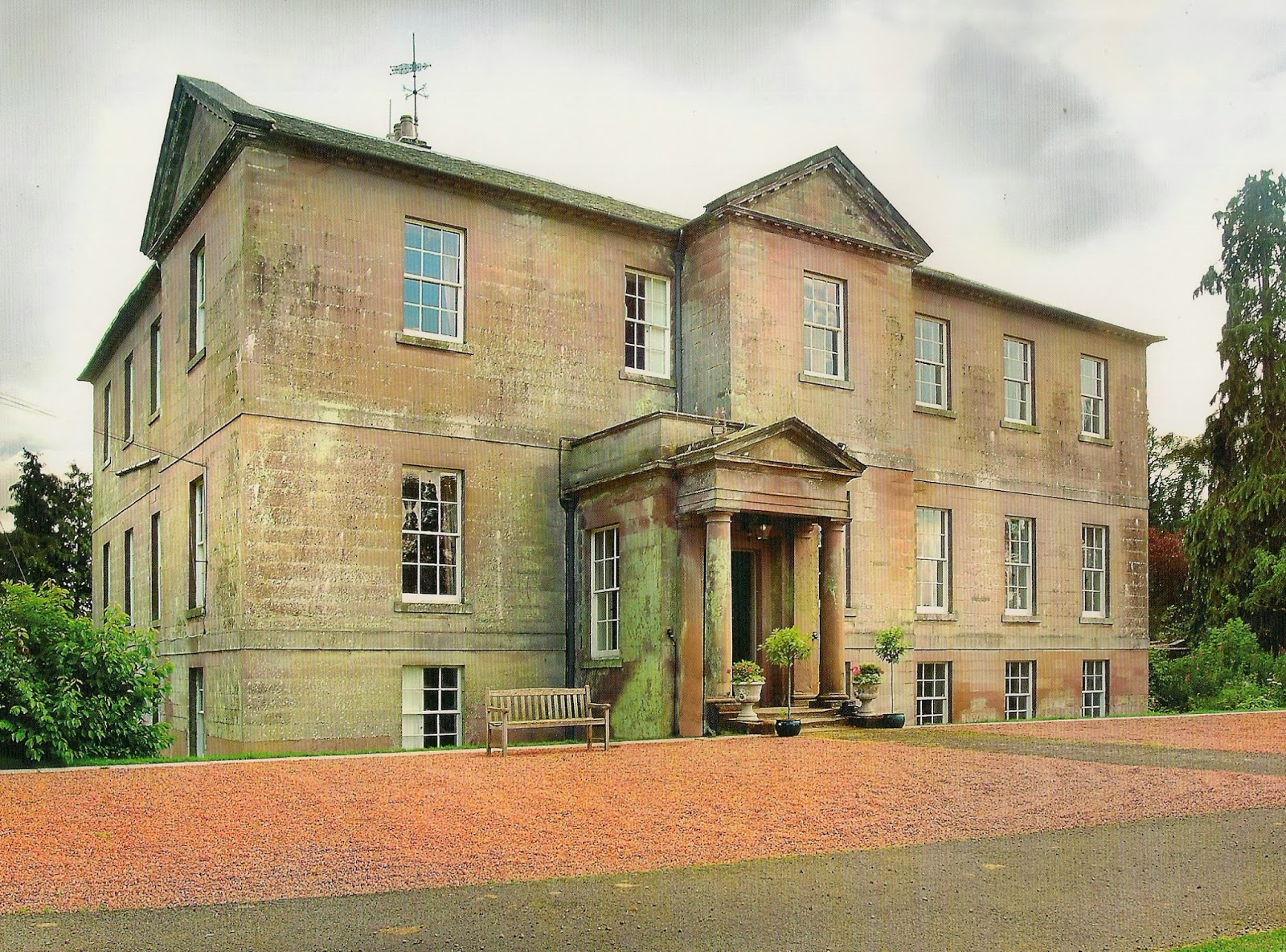
This house was my inspiration for Larimer Hall, where Zoe’s unwelcome suitor, Neil Pengelly, lives with his brother Peter. In my book, Zoe can see the Hall from an upper room in her coach house; in reality several miles separate the properties.


This is Kelso town hall as seen from the window of Zoe’s favourite café. Actually I’ve cheated; there is no café there, just a tiny branch of Boots. And why does Zoe keep going there?


Many graveyards in the Borders are not adjacent to churches but on the outskirts of villages. This is the pretty entrance to a small graveyard which serves the village of Leitholm, on which I based much of my fictional village, Westerlea. Zoe attends a rather eventful burial here.


When Zoe is taken by her friend Kate for a fish supper in Eyemouth, the first thing she sees when she gets out of the car is Gunsgreen House which, Kate tells her, was built by an eighteenth-century gentleman smuggler. Later that evening, they bump into the people Kate blames for two recent deaths, although Zoe isn’t so sure.

I've already started preparing for the follow-up to No Stranger to Death by finding some more great locations. But first I need to get this book published . . .


Wednesday, 25 September 2013

#WordlessWednesday

I love the idea of #WordlessWednesday: a blog post consisting of just a picture. So here's my first. It is a preamble to my next full post, where I'll be talking about Borders locations which have inspired my writing. Here is one of them.


Wednesday, 5 September 2012

Going places

Picture by Paul Stevenson, @goldylookfleece
I’m doing my best to apply the lessons I learnt while writing No Stranger to Death to creating its sequel. This includes recognition of my shortcomings and finding ways around them, rather than railing against an inability to carry out tasks I’m certain other people could accomplish standing on their heads (which is itself a skill I never mastered).

Take descriptions, especially of buildings and places. I am, apparently, one of a rare breed: under-writers. My first draft of anything is pretty sparse and editing usually means adding words rather than taking them away. I lost marks for this in my most recent OU course, with my tutor telling me that although I ‘write well’, my sentences and paragraphs are far too short for the academic world. 

While a propensity for brevity isn’t necessarily a bad thing if your main aim is to tell a first-rate story, it does stand in the way of conjuring up the magic ingredient which writers these days are encouraged to strive for: a sense of place.

I didn’t choose to set my books in the Scottish Borders simply because it’s ‘what I know’, but more because it’s what my main character doesn’t know. As an incomer to rural Scotland from an English city, Zoe isn’t just challenged by unfamiliar people and disturbing events but by these alien surroundings. She comes across sights, sounds and smells she’s never experienced before, and yet – alright, I admit it, like me – she finds unexpected pleasure in many of them and gradually starts to feel at home. This is all part of her ‘journey’, her personal development.

So, how to convey what the Borders is like? I’ll leave it to VisitScotland to inform the world about our castles, abbeys, stately homes and museums, and Zoe is unlikely to take up golf any time soon. This is where a notebook, latterly a smartphone, comes in handy. Sometimes driving, more often walking the dogs, I record the small things I encounter. The blue flash of a kingfisher, the sound of a chainsaw in the distance (would a true ‘townie’ know what it was?), the smell of woodsmoke. Stuff that makes me smile, like watching a border collie (what else?) herd sheep up a narrow road, and that makes me sad, like a young deer dead on the verge.

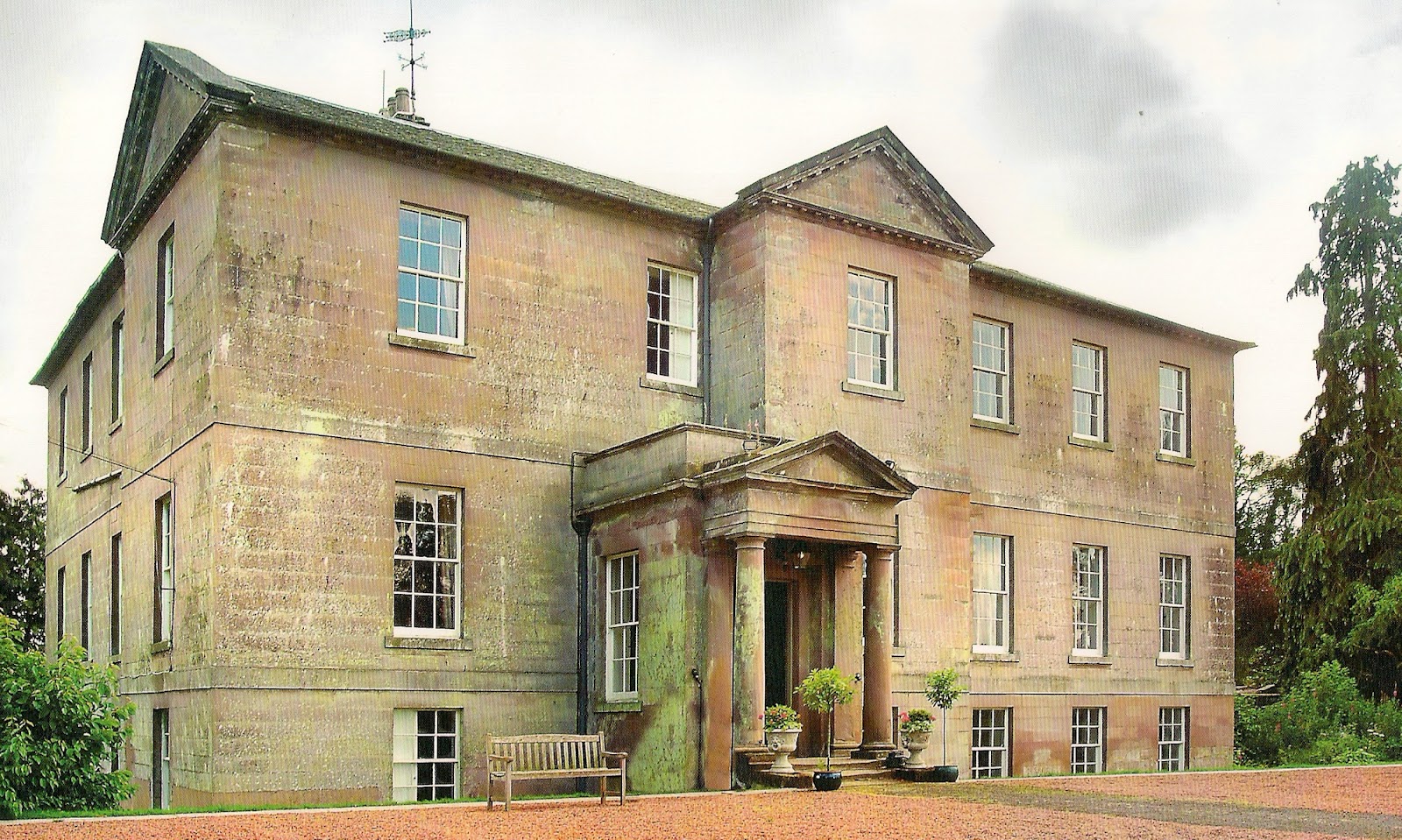
Rather than try to invent buildings, I use elements of existing ones. The picture below is  of a large house I’ve visited a few times in the past. Its frontage, galleried hall and huge coloured-glass skylight are combined in Book 1 with the kitchen and a dressing-room from another house I worked at for a time. 
An ideal setting for unpleasant goings-on?
For more general views of the area, I know I can turn to Twitter friends who are keen photographers. Paul Stevenson, who goes by the Twitter name of @goldylookfleece, kindly emailed me the gorgeous picture at the top of this post (and agreed to it appearing here) when I asked him if he had any landscapes with poppies.

When I need to write a detailed description of a particular setting, I go in search of one or maybe several which can be combined. Book 2 opens with the discovery of a body which has been pulled out of the River Tweed after being thrown off a nearby bridge. I was pretty certain the Union Chain Bridge, which links England and Scotland a few miles from Berwick-upon-Tweed, would be suitable.


The Tweed: England on one side, Scotland on the other

The Union Chain Bridge
I found lots of photographs online of this bridge, as it’s famous for being the oldest suspension bridge still carrying road traffic. However, my recent visit told me so much more than a Wikipedia entry and Flickr images could. For example, the Union Chain Bridge:
  • undulates when a car goes over it, which feels like you’re standing on a boat
  • creaks and groans, and if there’s a breeze the vertical struts rattle
  • is partly covered in green paint that’s flaking off in large patches
Not pretty but ideal for my purpose
These observations have enabled me to describe not just the bridge itself but Zoe’s experience of it. And – an unexpected bonus – that flaking paint has become a clue for the police when deducing how the body ended up in the Tweed

Perhaps when I’m published I won’t have time to research locations away from my desk. But until then I shall continue to seek them out, take photographs and note other details such as sounds and smells, to enrich my writing.

Do you feel the need to base your locations on real places, or is it just me?